

Love & the Law: The Color of Love, So Sayeth the Law

In the first part of this series, \”Love & the Law,\” I discussed the undergirding of the marital relationship – privacy. This second part of the series examines a case that challenged the legal definition involving what parties to a marriage should look like, literally. Loving v. Virginia, which was handed down by the U.S. Supreme Court a little more than 45 years ago to this day, banned laws prohibiting blacks and whites to marry. The facts of the case are fairly straightforward: In 1958, Mildred, who was African American, and Richard (Loving), who was white, lived in Virginia and were married in Washington D.C. They returned to Virginia to live and were charged and found guilty of violating Virginia state laws. The first law the Lovings violated was leaving the state to get married with the intent of returning to live as spouses when such a marriage was prohibited by Virginia state law, and theirs was such a marriage. In Virginia, interracial marriage was a felony, ergo, the second Virginia statute they violated, carrying with it prison time of 1 to 5 years. The Virginia court suspended their sentence for 25 years if, however, Mildred and Richard agreed to leave Virginia for the same length of time. The couple agreed and left, but they also appealed. The Supreme Court of the United States found that the State of Virginia had no rational reason for a law prohibiting interracial marriage. The Court stated that it “cannot conceive of a valid legislative purpose…which makes the color of a person’s skin the test of whether his conduct is a criminal offense.” Clearly, to be found guilty of a crime for an immutable characteristic was and is ludicrous. The Court further held that the freedom to marry has long been recognized as one of the vital personal rights essential to the orderly pursuit of happiness by free men. Accordingly, Loving resulted in the recognition that marriage is a fundamental right to be enjoyed by persons regardless of their racial or ethnic origins as detected by one\’s skin color. The Love & the Law Episodes: Brief Case History | Contraceptives | The Color of Love | The IRS v. NY | Privacy? No. Sex? No. History? No. Liberty? Yep. Pt 1 | Privacy? No. Sex? No. History? No. Liberty? Yep. Pt 2
Love & the Law: Contraceptives

Updated May 27, 2023 As mentioned in last week’s post, to celebrate Pride month and advocate marriage equality, this piece and a few subsequent posts will revisit landmark cases in the area of “Love and the Law.” The first case on our docket is Griswold v. Connecticut, which the U.S. Supreme Court decided in 1965. Though the issue in Griswold was whether a state law violated a married couple’s right to privacy and the Opinion of the Court, written by Justice Douglas, asserted that it did, the concurring opinion written by Justice Goldberg provided the more compelling arguments and analyses. Facts Griswold was the Executive Director of Planned Parenthood in Connecticut and, with a licensed physician, advised a married couple on how to use contraceptives. At the time, Connecticut state law prohibited using contraceptives and also prohibited helping a person commit crime. Consequently, Griswold and the doctor were found guilty of assisting the married couple in the commission of a crime. The State argued that the case analysis should be based on the Due Process Clause of the Fourteenth Amendment as it relates to economic, business, or social situations. The Court disagreed and stated that Griswold didn’t involve those situations, but instead involved the “intimate relation of husband and wife and they physician’s role in one aspect of that relation.” The Court next discussed the various penumbras, i.e., implied rights, included in the Bill of Rights, particularly those of the First Amendment, such as the freedom to associate with others and the right to privacy. Within the right to privacy, the Court further explained, previous case law found privacy zones such as one’s house, person, papers, or effects. Finally, putting it all together, the Court stated that Griswold involved a case about a relationship – an “association” – within a fundamental zone of privacy, a married couple’s house. Accordingly, there could be no rational reason for having this kind of law. In his concurrence, Justice Goldberg fleshed out the reason why certain rights are “fundamental” in the first place: “In determining which rights are fundamental, judges are not left at large to decide cases in light of their personal and private notions. Rather, they must look to the \”traditions and [collective] conscience of our people\” to determine whether a principle is \”so rooted [there] . . . as to be ranked as fundamental.\” Goldberg related the fundamental rights to the pursuit of happiness (read Loving v. Virginia) as discussed by the Founders along with the “right to be let alone”; sounds familiar? We\’ll get to Lawrence v. Texas, in a little bit. Goldberg then unequivocally stated that where fundamental rights are at stake, rational basis review (the lowest hurdle a law must overcome to pass constitutional muster) cannot be the standard of review for the law at issue affecting those rights. Unfortunately, Goldberg also included homosexuality in the acceptable array of intimate acts that the State also prohibited. However, this was 1965 and the courts were getting their fill of individual rights issues with the civil rights movement focused on racial equality. Lawrence, which decriminalized sexual activity between gays and lesbians, was almost 20 years away, but Griswold, albeit with this hiccup, was a start in the equality movement, recognizing marriage as a private, fundamental right for couples, irrespective of contraceptive use. The Love & the Law Episodes: Brief Case History | Contraceptives | The Color of Love | The IRS v. NY | Privacy? No. Sex? No. History? No. Liberty? Yep. Pt 1 | Privacy? No. Sex? No. History? No. Liberty? Yep. Pt 2
Love & the Law: Case Histories At-A-Glance
Updated May 27, 2023 Recently, courts across the country have handed down several decisions involving LGBT relationship rights. Additionally, June 12 was the anniversary of the U.S. Supreme Court ruling in Loving v. Virginia, which held that laws prohibiting interracial marriage were illegal. Because the U.S. Supreme Court is the final arbiter of what is law in the United States, many speculate that the Court is going to eventually rule on the issue of same-sex marriage. So over the course of the next couple of months, I’ll provide a little case history on the decisions below (Griswold, Loving, Bowers, Romer, Lawrence, Prop 8, and Windsor) considered landmark decisions by many in the area of privacy and relationship rights. Windsor v. U.S. is not a Supreme Court case, but may be headed there just the same, and Proposition 8 (\”Prop 8\”) involves the California statute banning same-sex marriages that was ruled unconstitutional by the Ninth Circuit. Proponents of Prop 8 have already stated that they will appeal it to the the U.S. Supreme Court. Why does this matter to estate planners? Because we plan for families and the recent decisions are pointing toward a fundamental shift in the national, legal definition of family.
Love & the Law: The IRS v. NY
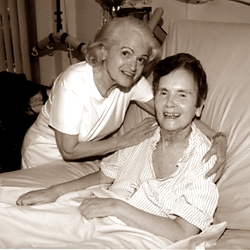
Edie and Thea had been together for more than 44 years; they became one of the first registered domestic partners of New York; and as Thea\’s health began failing dramatically, the couple legally married each other in Toronto, Ontario, Canada. When Thea died a few years after their lifelong relationship and marriage, the federal government refused to recognize their marriage and taxed Edie\’s inheritance from Thea as though they were strangers. Under federal tax law, a spouse who dies can leave her assets, including the family home, to the other spouse without incurring estate taxes. Ordinarily, whether a couple is married for federal purposes depends on whether they are considered married in their state. New York recognized Edie and Thea\’s marriage, but because of the so-called the \”Defense of Marriage Act,\” or DOMA, the federal government refuses to treat married same-sex couples, like Edie and Thea, the same way as other married couples. After spending decades together, including many years during which Edie helped Thea through her long battle with multiple sclerosis, it was devastating to Edie that the federal government refused to recognize their marriage, their loving and solemnized dedication to each other. With representation by the American Civil Liberties Union, the New York Civil Liberties Union, and the law firm of Paul, Weiss, Rifkind, Wharton & Garrison LLP, Edie challenged the constitutionality of DOMA and seeking a refund of the estate tax she was unfairly forced to pay. Edie alleged that DOMA violates the Equal Protection principles of the U.S. Constitution because it recognizes existing marriages of heterosexual couples, but not of same-sex couples, despite the fact that New York State treats all marriages the same. On June 6, 2012, Judge Barbara Jones ruled for Edie and against the IRS, stating that Section 3 of DOMA as it applies to legally married same-sex couples for purposes of estate taxation is unconstitutional. Though this isn\’t a Supreme Court ruling and, therefore only persuasive outside of NY, it is a large and critical step in the undoing of DOMA. The Love & the Law Episodes: Brief Case History | Contraceptives | The Color of Love | The IRS v. NY | Privacy? No. Sex? No. History? No. Liberty? Yep. Pt 1 | Privacy? No. Sex? No. History? No. Liberty? Yep. Pt 2
Will the U.S. Supreme Court Embrace Love Again?
On May 30, Lambda Legal and the ACLU filed lawsuits against the Illinois Cook County Clerk’s office alleging that the Clerk’s office discriminated against same-sex couples who wanted to get married in Cook County. The Clerk’s office has consistently turned away LGBT couples who requested marriage licenses because though Illinois passed the Illinois Religious Freedom and Civil Union Act (Civil Union Act), the Illinois Marriage and Dissolution of Marriage Act (IMDMA) still states that same-sex marriage is against the state’s public policy. Additionally, the Illinois legislature failed to pass the bill proposing same-sex marriage legalization for Illinois. Illinois, similar to the U.S., has a conflicting legal perspective on same-sex marriage. The Civil Union Act states that LGBT couples who enter into Civil Unions have the same obligations, benefits, rights and burdens as married straight couples in Illinois. Yet, the IMDMA states that Illinois citizens are against same-sex marriage. Ironically, high-ranking government and judicial authorities across the nation are not in conflict: President Obama has denounced the so-called Defense of Marriage act (DOMA) as unconstitutional; The First Circuit Court has recently ruled Section 3 of DOMA as unconstitutional; The Ninth Circuit rejected an appeal for an en banc hearing on its decision that Prop 8, the California law banning same-sex marriage in California, was unconstitutional as applied to California citizens; Illinois Governor Pat Quinn supports same-sex marriage; And more than a dozen states also have laws that either allow same-sex marriage or provide a process where LGBT couples can receive substantially similar legal treatment to heterosexual married couples. However, that is the point – substantially similar is not equal – and all of the United States of America, including Illinois, should provide more. As I explained in an earlier post, the government providing rights to one group and denying those same rights to another group, simply because of an immutable characteristic that certain citizens don\’t like is unconstitutional; it is blatant discrimination. Accordingly, DOMA, which defines marriage as a union between one man and one woman as husband and wife, violates the United States Constitution because it validates harmful and irrational discrimination. Furthermore, DOMA places states that allow for same-sex marriages and civil unions in a legislative quagmire, where the states can provide benefits to LGBT couples as long as those benefits aren’t derived through federal programs. Because of the inherent discord between the individual states, the Legislative Branch, the Executive branch, and the Judicial Branch, increasing speculation is that the issue will reach the U.S. Supreme Court. That may be a good thing or it may be a not-so-good thing. The composition of the Court is conservative, so if it decides to take the case, it may use historical analysis and side with DOMA’s proponents. A number of members of the Court believe that the Constitution should be interpreted using the values and perceptions of the time in which it was written – the 18th century. I care not to argue the ridiculousness of that rationale. The next scenario is that the Court could decide not to hear the case, reasoning that “Congress has spoken” by passing DOMA. So then, Congress would need to speak again to invalidate the law. Given the tumult in Congress and the blockade against getting anything done, it is unlikely that Congress would even put repealing DOMA on its “to get to” list, let alone its “to do” list. The last scenario is that the Court would take the case and rule in favor of DOMA’s opponents and rule Section 3 or all of DOMA is unconstitutional. Hmmm…. Given that 2 out of 3 scenarios point to a no-win situation for LGBT couples, taking the fight to this Supreme Court is an eyebrow-raiser, at the very least. Still, one can hope that the Court would respect the more than 40 years of precedent, ala Loving v. Virginia, and progression, ala Romer v. Evans, and Lawrence v. Texas. But then, there’s that Citizens United decision, which overturned about 100 years of precedent.
80% Get It Wrong…
In the digital age, it\’s rare that potential clients haven\’t done research before contacting our firm. So, when speaking or meeting with them, it\’s important to hear what they\’ve found. Sometimes it\’s factually correct, but not for their case; sometimes it\’s factually incorrect with respect to their case; and often the pieces just don\’t fit together at all. So then I say, \”Think about this…\” And, as colleagues continue to criticize DIY services, as online legal documents services proceed with IPOs, and as folks continue to ask me to opine, I thought these few facts may be worth sharing:
3 Lessons from Summer Disaster Flicks
One hallmark of summertime in the U.S. is the onslaught of disaster movies. For me, there’s nothing like a great “the-world-is-under-attack-so-blow-‘em-up-real-good!” movie. So when temperatures crept into the 80s and trailers for “world under attack” started showing on TV, I couldn’t help but think about the “disaster” provisions in estate planning documents, aka “contingent beneficiary” provisions. Also, while reading a couple of cases and thinking about questions frequently asked by clients, I knew I had a winning screenplay, or a half-way decent blog post. So grab your popcorn and enjoy the move…I mean post. Ornery old Great-Grandma Cornelia Stamper decides to write her will and leaves one of her oil wells to her son, Harry. She names it “Harry Stamper’s Well.” Before she dies, though, Harry marries Anna and he and Anna have a daughter, Grace. Cornelia isn’t so keen on Anna, so she draws up a trust leaving income from the “Family Stamper’s Well” to Harry for his life and upon Harry’s death, the income from the well should be distributed equally among Cornelia’s heirs. Cornelia dies at the grand old age of 98 and Harry then draws up a trust leaving Harry Stamper’s Well to Grace and continues his life’s work – drilling in Alaska. Suddenly one day, Harry learns from his buddies at NASA that an asteroid is headed for Earth. Harry then changes his trust and adds a charitable contribution provision, giving part of the income from Family Stamper’s Well to the Red Cross and Medicins Sans Fronteirs and the rest to his descendants. Also, Grace has a trust created and leaves the income from Family Stamper’s Well to the same 2 charities. Fortunately, Harry’s NASA buddies blow the asteroid up real good and none of the particles cause any damage to Earth. A year later, while drilling near Russia, Harry is told that aliens attacked Earth and wiped out all his relatives including, Grace. Harry’s heart can’t take it and he dies. However, Grace actually escaped the attack but is the only Stamper left. Grace’s friends, David and Steven, however, blow up the alien ship real good and things return to normal – kinda. Half the world’s population is gone, so the Red Cross and Medicins Sans Frontiers have a lot of work to do. They are counting on Harry’s gift and know that the funds are available because the banks were saved. Go figure. Accordingly, they hire a lawyer; lots of us survived. But their meeting with the lawyer didn’t go well. My clients know why because these were their questions: 1. Can income from a life estate be given away by the owner of the life estate? In other words, could Harry bequeath income from Family Stamper’s Well? No. Cornelia left the income to Harry for his life only and then to Cornelia’s heirs. So unless Grace is feeling charitable during her lifetime, the nonprofits are out of luck until Grace dies. 2. What would have happened if Grace died in the alien attack but Family Stamper’s Well had dried up? In other words, what happens when the “gift” is no longer in the estate? If Grace knew the well was drying up and didn’t change her trust to provide for this event, then the gift would be considered “revoked,” or \”adeemed\” in legalese, and the charities out of luck. If Grace didn’t know and say the well was destroyed by the aliens, then the gift is still considered revoked unless she provided in the trust that the loss should be covered by insurance. 3. What would have happened if Grace died and she didn’t name anyone to take the income? That’s the real disaster. With all of the Stamper beneficiaries dead and no charity named, the income and well would probably go to the remaining population – bankers and lawyers.
Debunking Estate Planning Myths & Developing Weath, pt 5
Finally finishing the “Debunking Estate Planning Myths” series, as discussed in part 4, revocable living trusts let individuals place more than land into a trust. Doing so typically prevents beneficiaries from going through probate, allows other vehicles to grow tax free, and keeps the terms of the estate distribution private. Also, not only do trusts save beneficiaries the time and expense of opening a probate estate, but trusts also minimize estate tax exposure for beneficiaries. Tax minimization relates directly to another intermediate but classic estate planning tool and technique – an irrevocable life insurance trust (ILIT). ILITs are a combination of 2 estate planning tools, a trust and life insurance, used to minimize estate tax burdens for beneficiaries. Life insurance proceeds that would be considered part of the estate are used to fund a trust and deemed removed from the estate altogether. A number of criteria have to be met, such as using a policy that the insured has no interest in the policy, e.g., does not withdraw the cash from a cash value policy. However, if we think about it, typically we don’t buy life insurance for investment purposes but only for income replacement purposes. So if we’re not planning to use the life insurance, then why not let it benefit our loved ones in more than one way and place it in an ILIT? Using particular language in children’s trust provisions is another way to provide beneficiaries with the time needed to mature before having substantial means placed into their hands. Provisions with this language are called “staggered mentoring” provisions, which instruct the trustee to distribute certain percentages of the total trust funds to the children at ages 25, 30, and 35 years, for example. Parents also can place conditions on distributions so that a child doesn’t receive a distribution unless he or she performs on at least an average academic level in college and becomes a productive member of society. Mentioning this tends to result in a few “likes” by parents on my Facebook page. Trusts are also used to provide enhanced tax minimization for the surviving spouse. By using the federal marital deduction and other available elections, families can defer the payment of estate tax payments of the first spouse until the second spouse’s death. Another way that trusts are used is to provide for surviving spouses, partners, and children using retirement proceeds. Typically, beneficiaries should be named directly on retirement accounts. Under certain situations, the retirement account should be maintained as an “inherited” account, and occasionally a trust should be named beneficiary where the individual beneficiary is dependent on a trustee. The trustee then pays out the proceeds over the lifespan of the beneficiary as opposed to the original account owner. Because trustees are the actual legal owners of the trust property, beneficiaries may be protected from creditors because trustees can be given sole discretion to distribute funds, and may pay institutions, such as colleges and hospitals directly. Part 1 | 2 | 3 | 4 | 5
Blood or Money? Making Fiduciary Designations that Maintain Family Harmony

Tons of articles have been published advising individuals and couples about what to bring to or how to prepare for a meeting with your estate planning attorney. Most of these articles provide the typical list: financial statements, copies of tax returns, mortgage statements, retirement information, and so forth. Not surprisingly, few articles discuss the “hard list”: names of successor guardians for the children, names of successor trustees – particularly if the children have trusts, how special gifts will be distributed, and who should hold title to the home for asset protection purposes. A previous post discussed guardians but another issue that couples may want to consider is how to maintain family accord for the children’s benefit when a member from one spouse’s side of the family may be emotionally closer to the children than a member from the other spouse’s side, but both families want to be involved in the event of an emergency. Under those circumstances, the harmonious decision to name Uncle Louie Guardian and Uncle Gus as Trustee, for example, may be not-so-harmonious. Baby Gina’s and Big Brother Brett’s Uncle Louie on Mama’s side and Uncle Gus on Papa’s side may in fact have a great relationship. However, designating one guardian and the other trustee may place a strain on the relationship that would cause Robin to reconsider his relationship with Batman. Consequently, designating one person as both guardian and trustee would probably be more prudent. Plus, Uncle Gus might even appreciate it once you shared with him the critical and long list of duties a trustee must agree to undertake. Still, what if Uncle Gus is a control freak and would wreak havoc on the rest of you and your spouse’s living days if some authority wasn’t given to him? In that case, you could make Uncle Gus the Executor of the estate. But what if that wasn’t enough? Perhaps he would be satisfied with being the successor trustee of the family trust funds that remained after the children’s trust was fully funded. And if Uncle Gus wasn’t satisfied with that and Uncle Louie refused to switch places? Then consider the following 2 options: Creating a solid co-trustee agreement between the 2 uncles; or Designate a corporate trustee to manage the children’s trust. Sometimes to maintain family accord, retaining a reasonable corporate trustee is the only option. Yes, money leaves the estate but at least it\’s money and not blood.
2 Lessons from a Single Mom Held Hostage
One of the most important steps a single parent can take to protect his or her child is to plan for the unexpected. I don’t point it out often, but the fact is that one of the primary services offered by the Law Offices of Max Elliott is helping people plan for the day they die. Nobody likes to think about this, let alone talk about it, especially parents – moms and dads. Given that challenge, consider the following true story (with identifying characteristics changed): Molly and Sheldon had been dating for a couple of years but weren’t ready to get married. Sheldon was a struggling actor and Molly was fresh out of college. However, circumstance resulted in Molly having Sheldon’s little girl, Amy. Sheldon and Molly decided against marriage or entering into a Civil Union but both loved Amy dearly. One day while returning from work, Molly was killed in a car crash. Fortunately, she had life insurance. BUT… 1. She listed Amy as the primary beneficiary with no further instruction. 2. She listed Sheldon as the contingent beneficiary with no further instruction. 3. She didn’t tell her only other remaining “next of kin” about her “final wishes.” So… Molly’s body was sent to a funeral home selected by her only remaining next of kin, who could not afford to pay for the funeral services but, when meeting with the funeral home director and Sheldon, mentioned the life insurance policy. The funeral home agreed to perform the services that week only if they could be guaranteed payment through the insurance proceeds. For this to occur to the satisfaction of the funeral home, Sheldon, who was on Amy’s birth certificate, would still have to go to court and agree to open an estate for Amy and a lawyer, referred to Sheldon by the funeral home, would have to be named trustee. The bottom line: If Sheldon didn’t want to take the funeral home up on its offer, during one of the most challenging times of a person’s life, I might add, he had to find the money elsewhere within 24 hours. Taking the funeral home’s offer meant: Retaining an attorney that neither he nor Molly knew to represent their little girl. Designating an attorney neither he nor Molly knew to be trustee for their little girl’s sizable estate at least temporarily; and here’s the other burn… Paying thousands of dollars of little Amy’s money to an attorney and a funeral home in order to hold Molly’s services within a reasonable time. This is a grim, real life story but I implore you to take and pay forward the critical lessons: DO NOT designate minors as primary beneficiaries of life insurance policies, retirement accounts, and the like. DO communicate to your loved ones your final wishes, so you and your loved ones won’t be held hostage.